



Disclaimer:
This document is for informational purposes only and describes the mechanics of the strategy as configured on the Quantiply platform. It is not financial advice. Past performance of any strategy does not guarantee future results. Please ensure you understand the risks involved before trading with real capital.
Strategy Overview:
This strategy involves selling NIFTY ATM option legs and uses the Journey feature to control what happens next based on how each trade plays out. Rather than simply closing the algo when a target or stoploss is hit and stopping there, the strategy continues into a predefined next action a follow-up leg depending on the outcome.
In short, the result of one leg determines what the strategy does next. If a leg hits its stoploss, one thing happens. If it hits its target, something else happens. This creates a dynamic, adaptive flow rather than a fixed one.
What is the Journey Feature?
Journey is a feature on the Quantiply platform that allows you to build a decision tree for your strategy. You define what follow-up action should be taken when a leg exits either via stoploss or via target. Each exit event triggers the next predefined leg in the sequence.
Think of it like a flowchart for your trades:
- Leg hits Stoploss → execute the follow-up leg assigned to the SL outcome
- Leg hits Target → execute the follow-up leg assigned to the TP outcome
This means the strategy does not stop when one leg exits. It adapts and continues based on what the market did.
Strategy Snapshot:
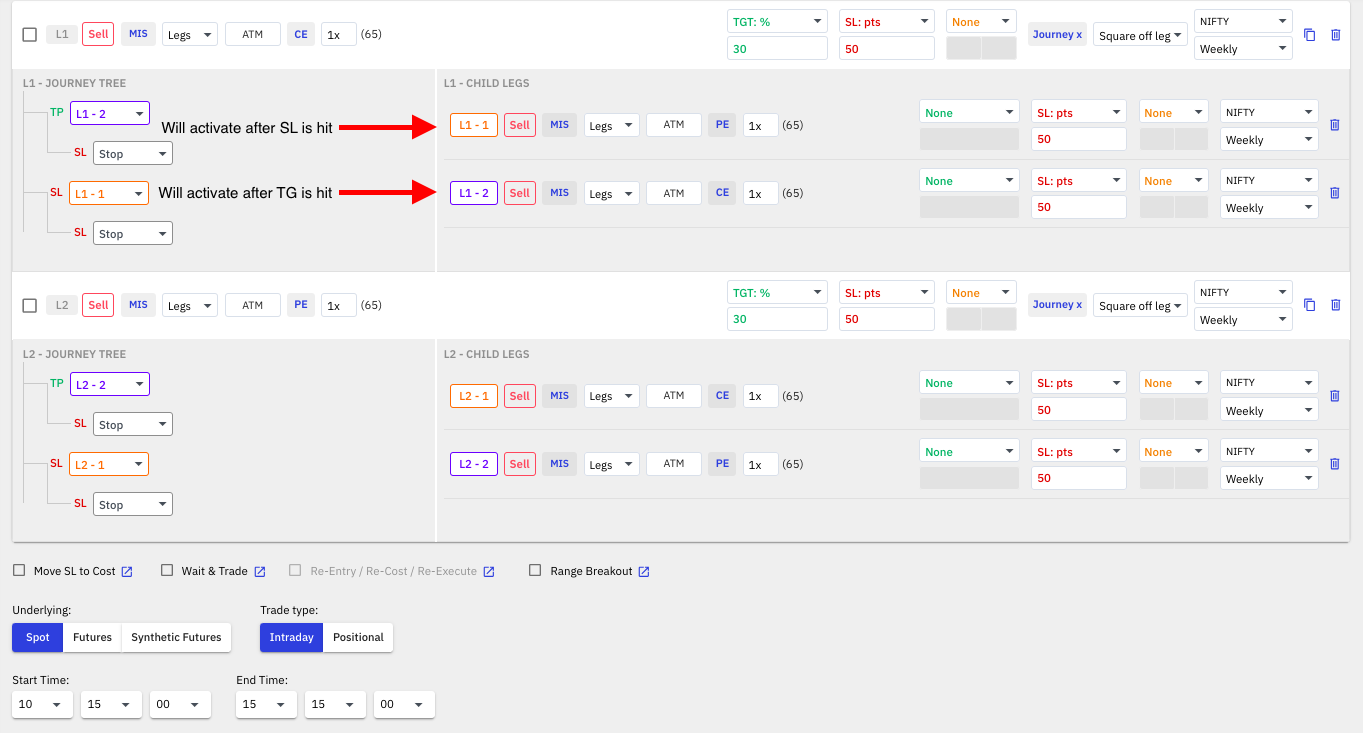 Overview of the key configuration parameters for this strategy
How the Execution Logic Works
Here is the step-by-step flow of how this strategy runs:
- The initial NIFTY ATM legs are sold at the defined start time.
- Each leg is monitored against its defined Stoploss (SL) and Target (TP) levels.
- When a leg exits either via SL or TP, the Journey configuration reads the outcome and determines which follow-up leg to execute as configured in the Journey settings.
From that point, the follow-up leg runs just like any other leg. It too has its own defined exit conditions, and if Journey is configured for it as well, the chain continues.
What happens when a Stoploss is triggered?
When a leg hits its stoploss, the system squares it off and immediately activates the next leg that has been assigned to the SL path in the Journey Tree. This follow-up leg is typically designed to recover, hedge, or reposition based on the direction the market has moved.
What happens when a Target is triggered?
When a leg hits its target, the system squares it off and activates the next leg assigned to the TP path in the Journey Tree. This could be a fresh entry to ride further movement, a hedge to protect existing profits, or simply a more conservative follow-up position.
Things to Keep in Mind:
- Each follow-up leg in the Journey must be configured in advance. The system does not make decisions on the fly it only executes what has been predefined in the Journey Tree.
- If a follow-up leg is not configured for a particular outcome (SL or TP), the strategy simply stops at that exit and does not continue.
- Journey legs follow the same entry and exit rules as any other leg. They can have their own stoplosses, targets, and even their own Journey configurations.
- This strategy is best understood as a decision tree, not a single trade. Plan the full tree before activating it, including all SL and TP branches.